 Riverland
Our composting method
Good feed starts
before the worm bed.
Microbes begin the work in the compost pile. Once the prepared feed has cooled, worms and microbes continue processing it in our beds.
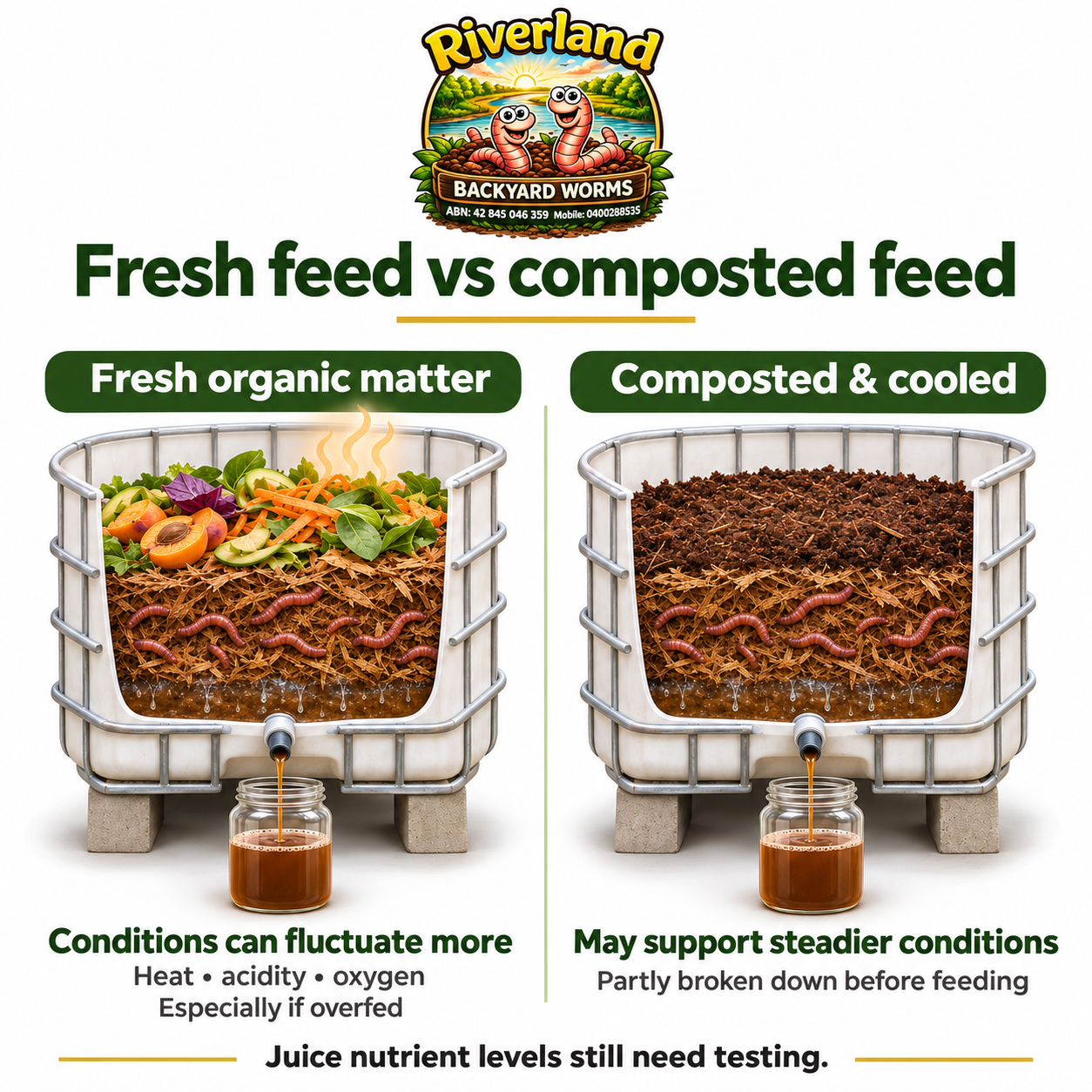
Fresh feed and composted feed
Same worms.
Different starting point.
Both fresh scraps and prepared compost can be processed by worms. Feed preparation changes where much of the intense early breakdown happens.
From green waste to worm food
Inside the composting process.
Explore the eight illustrated stages to see what happens to the material, which organisms do the work, and why the pile heats, cools and reheats.
These are educational diagrams. Temperatures and timings vary by material and system; the heating curve is illustrative. A fixed number of cycles does not establish maturity or pest removal.
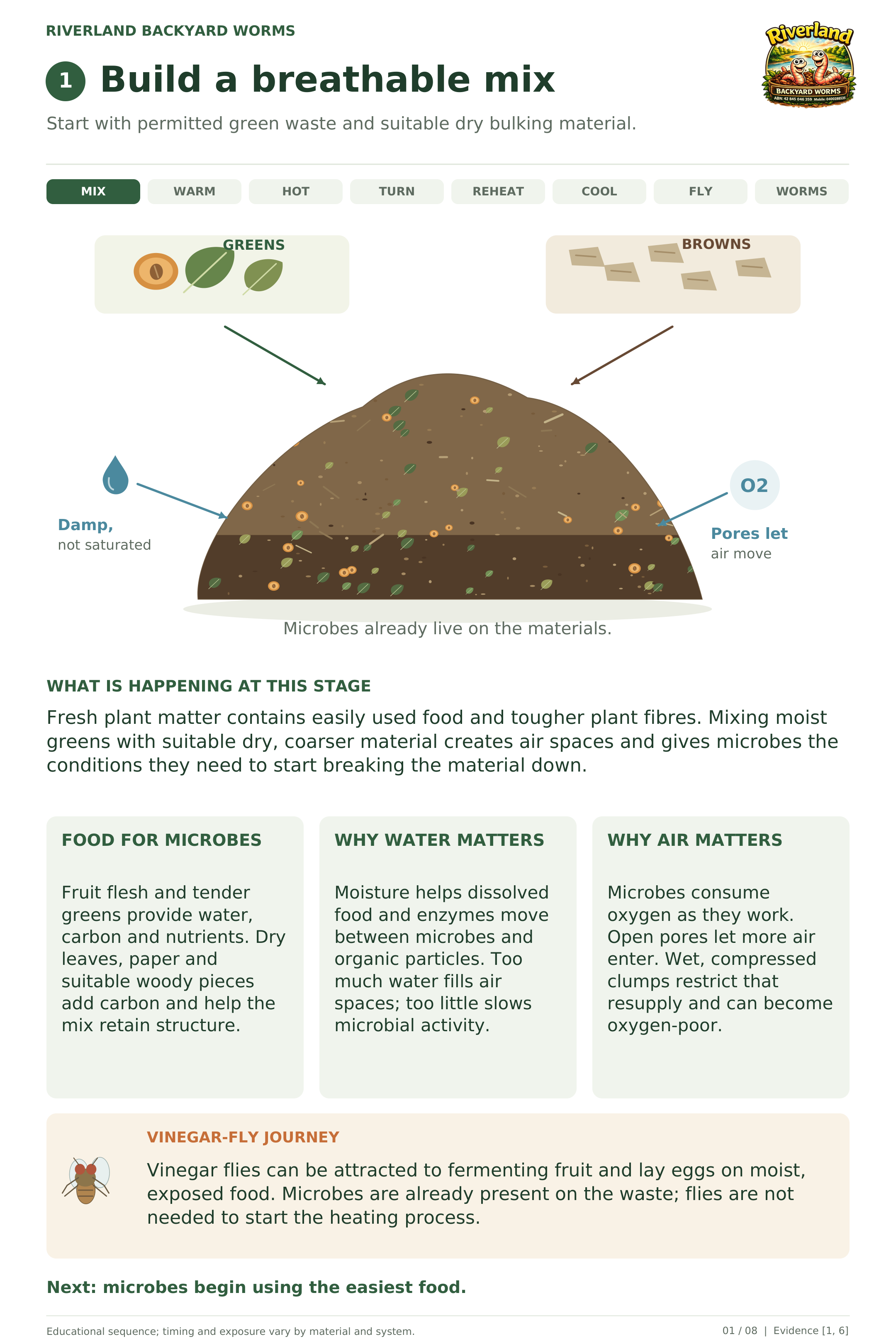
Build a breathable mixBring together plant material, moisture and spaces for air.
Fresh plant matter contains easily used food and tougher plant fibres. Mixing moist greens with suitable dry, coarser material creates air spaces and gives microbes the conditions they need to start breaking the material down.
Food for microbes
Fruit flesh and tender greens provide water, carbon and nutrients. Dry leaves, paper and suitable woody pieces add carbon and help the mix retain structure.
Why water matters
Moisture helps dissolved food and enzymes move between microbes and organic particles. Too much water fills air spaces; too little slows microbial activity.
Why air matters
Microbes consume oxygen as they work. Open pores let more air enter. Wet, compressed clumps restrict that resupply and can become oxygen-poor.
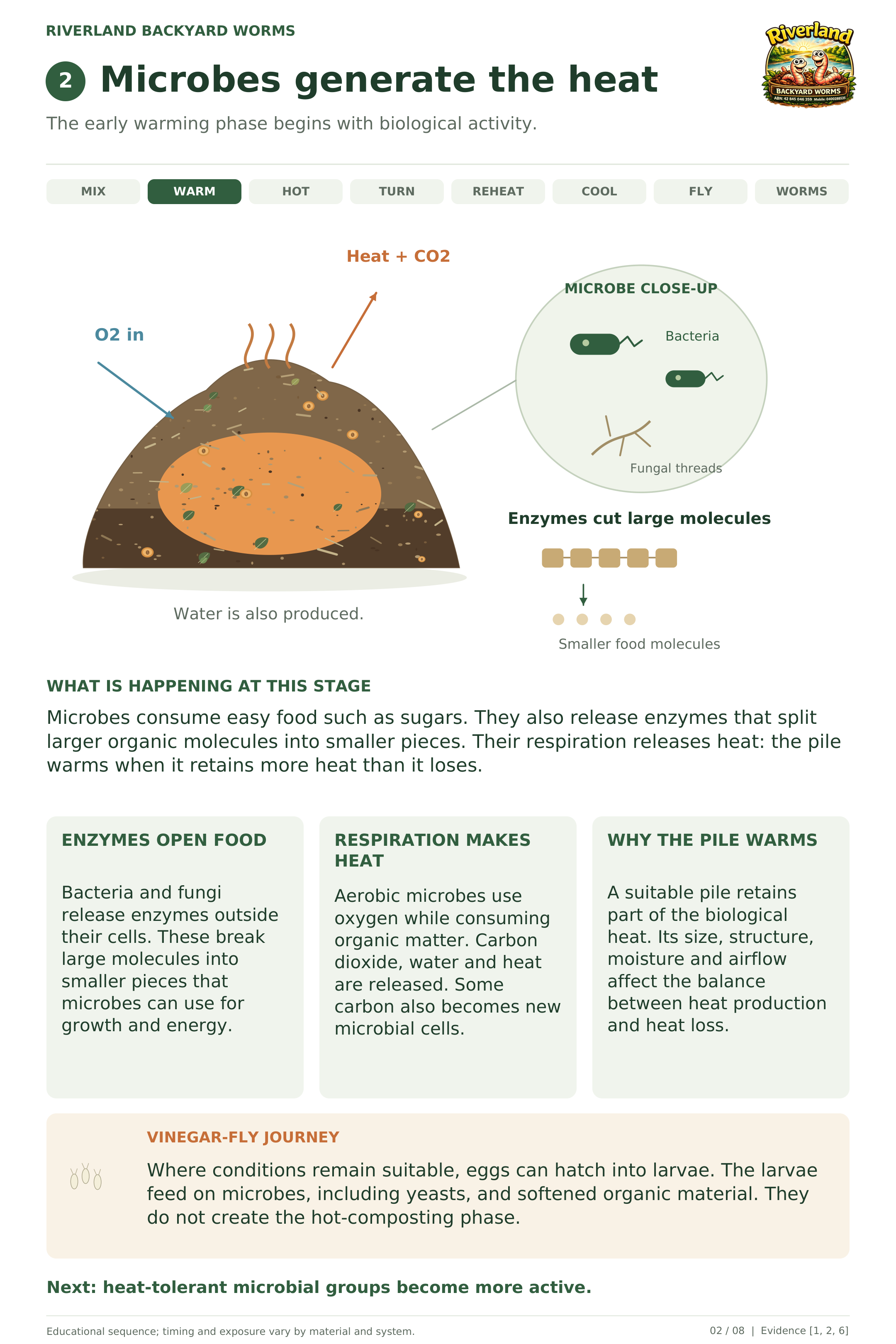
Microbes generate the heatMicrobes use food and oxygen, releasing heat as they work.
Microbes consume easy food such as sugars. They also release enzymes that split larger organic molecules into smaller pieces. Their respiration releases heat: the pile warms when it retains more heat than it loses.
Enzymes open food
Bacteria and fungi release enzymes outside their cells. These break large molecules into smaller pieces that microbes can use for growth and energy.
Respiration makes heat
Aerobic microbes use oxygen while consuming organic matter. Carbon dioxide, water and heat are released. Some carbon also becomes new microbial cells.
Why the pile warms
A suitable pile retains part of the biological heat. Its size, structure, moisture and airflow affect the balance between heat production and heat loss.
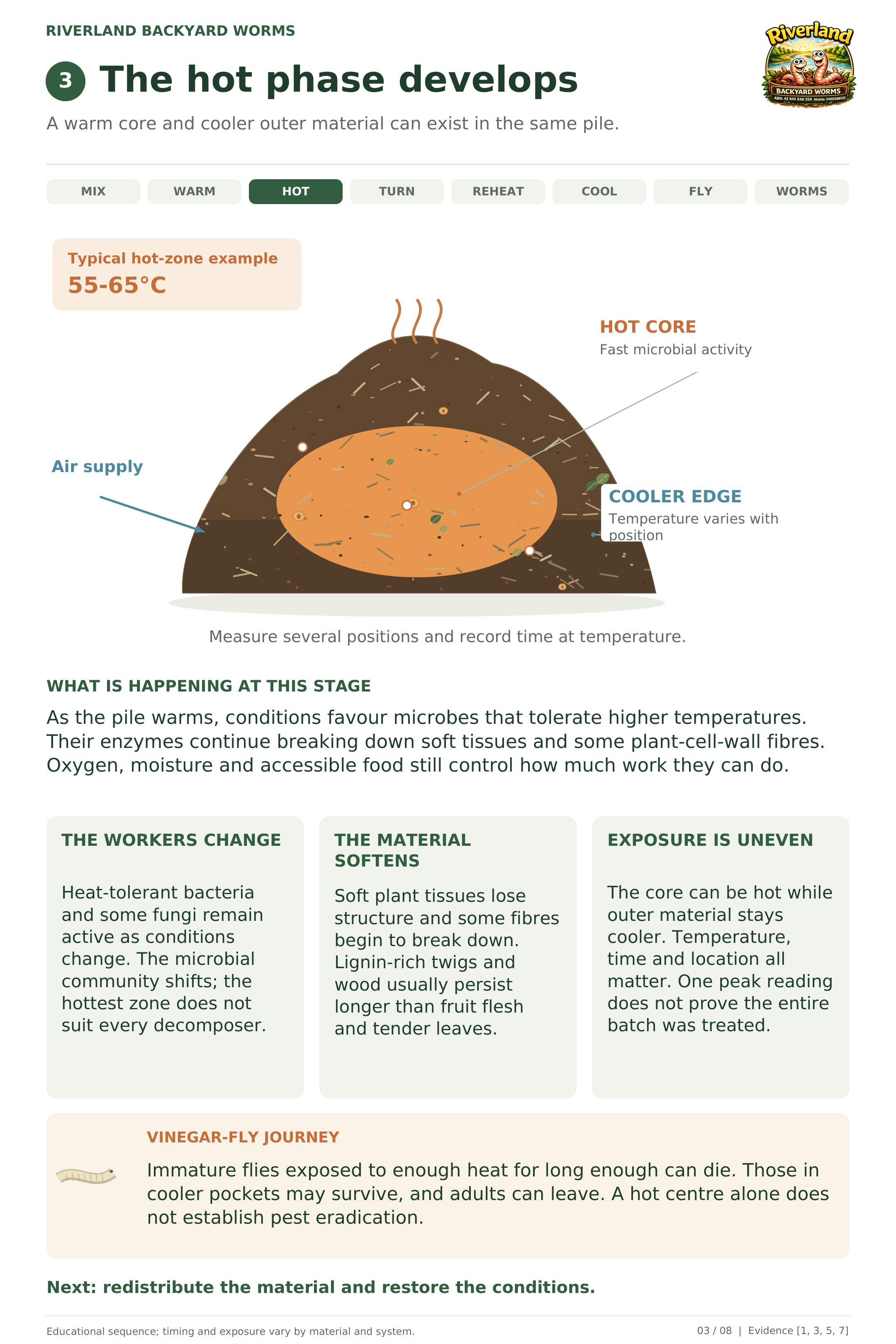
The hot phase developsHeat-tolerant microbes work in a pile with warmer and cooler zones.
As the pile warms, conditions favour microbes that tolerate higher temperatures. Their enzymes continue breaking down soft tissues and some plant-cell-wall fibres. Oxygen, moisture and accessible food still control how much work they can do.
The workers change
Heat-tolerant bacteria and some fungi remain active as conditions change. The microbial community shifts; the hottest zone does not suit every decomposer.
The material softens
Soft plant tissues lose structure and some fibres begin to break down. Lignin-rich twigs and wood usually persist longer than fruit flesh and tender leaves.
Exposure is uneven
The core can be hot while outer material stays cooler. Temperature, time and location all matter. One peak reading does not prove the entire batch was treated.
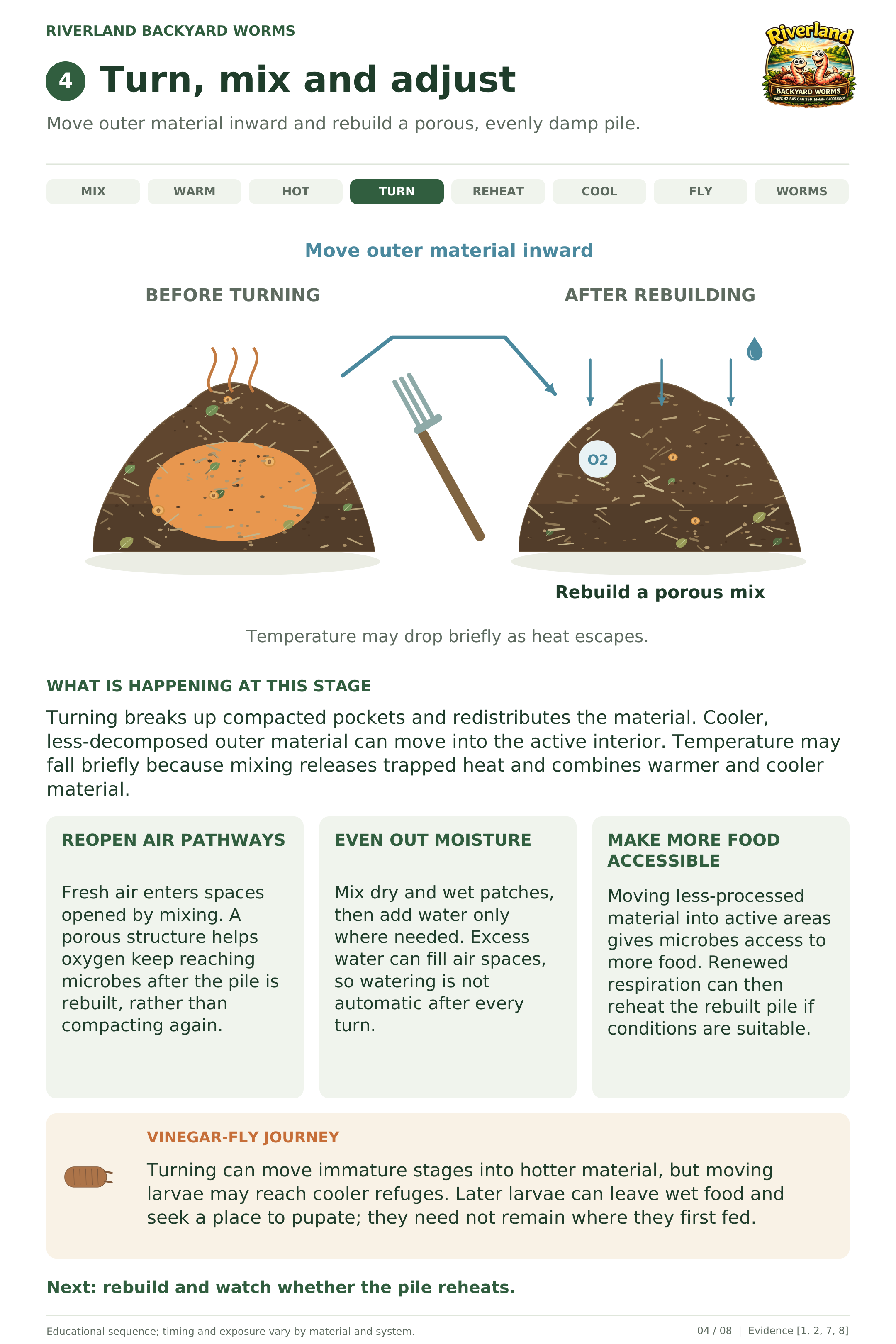
Turn, mix and adjustRedistribute the material and restore access to air and moisture.
Turning breaks up compacted pockets and redistributes the material. Cooler, less-decomposed outer material can move into the active interior. Temperature may fall briefly because mixing releases trapped heat and combines warmer and cooler material.
Reopen air pathways
Fresh air enters spaces opened by mixing. A porous structure helps oxygen keep reaching microbes after the pile is rebuilt, rather than compacting again.
Even out moisture
Mix dry and wet patches, then add water only where needed. Excess water can fill air spaces, so watering is not automatic after every turn.
Make more food accessible
Moving less-processed material into active areas gives microbes access to more food. Renewed respiration can then reheat the rebuilt pile if conditions are suitable.
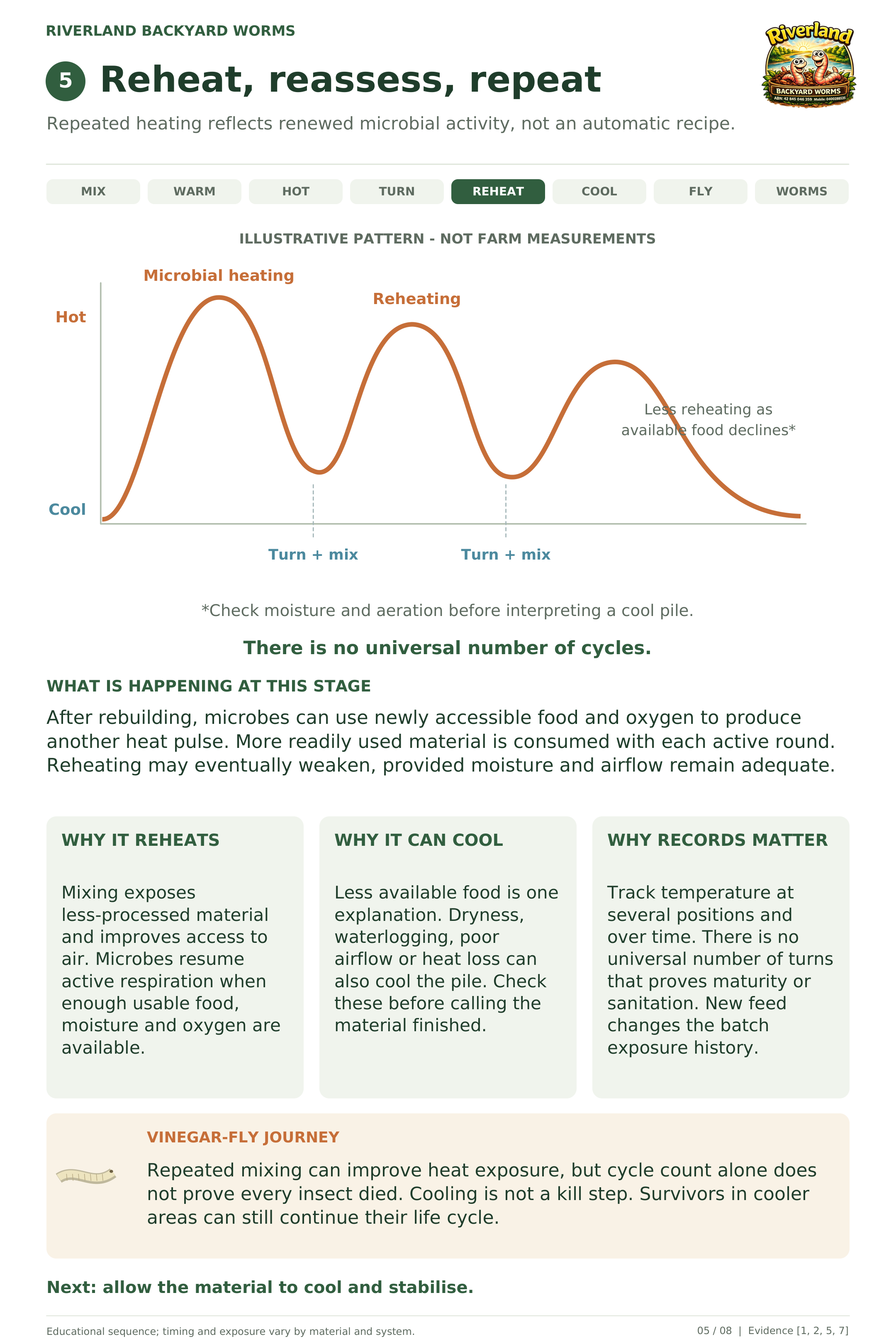
Reheat, reassess, repeatUnderstand the next heat pulse and why a pile can also cool.
After rebuilding, microbes can use newly accessible food and oxygen to produce another heat pulse. More readily used material is consumed with each active round. Reheating may eventually weaken, provided moisture and airflow remain adequate.
Why it reheats
Mixing exposes less-processed material and improves access to air. Microbes resume active respiration when enough usable food, moisture and oxygen are available.
Why it can cool
Less available food is one explanation. Dryness, waterlogging, poor airflow or heat loss can also cool the pile. Check these before calling the material finished.
Why records matter
Track temperature at several positions and over time. There is no universal number of turns that proves maturity or sanitation. New feed changes the batch exposure history.
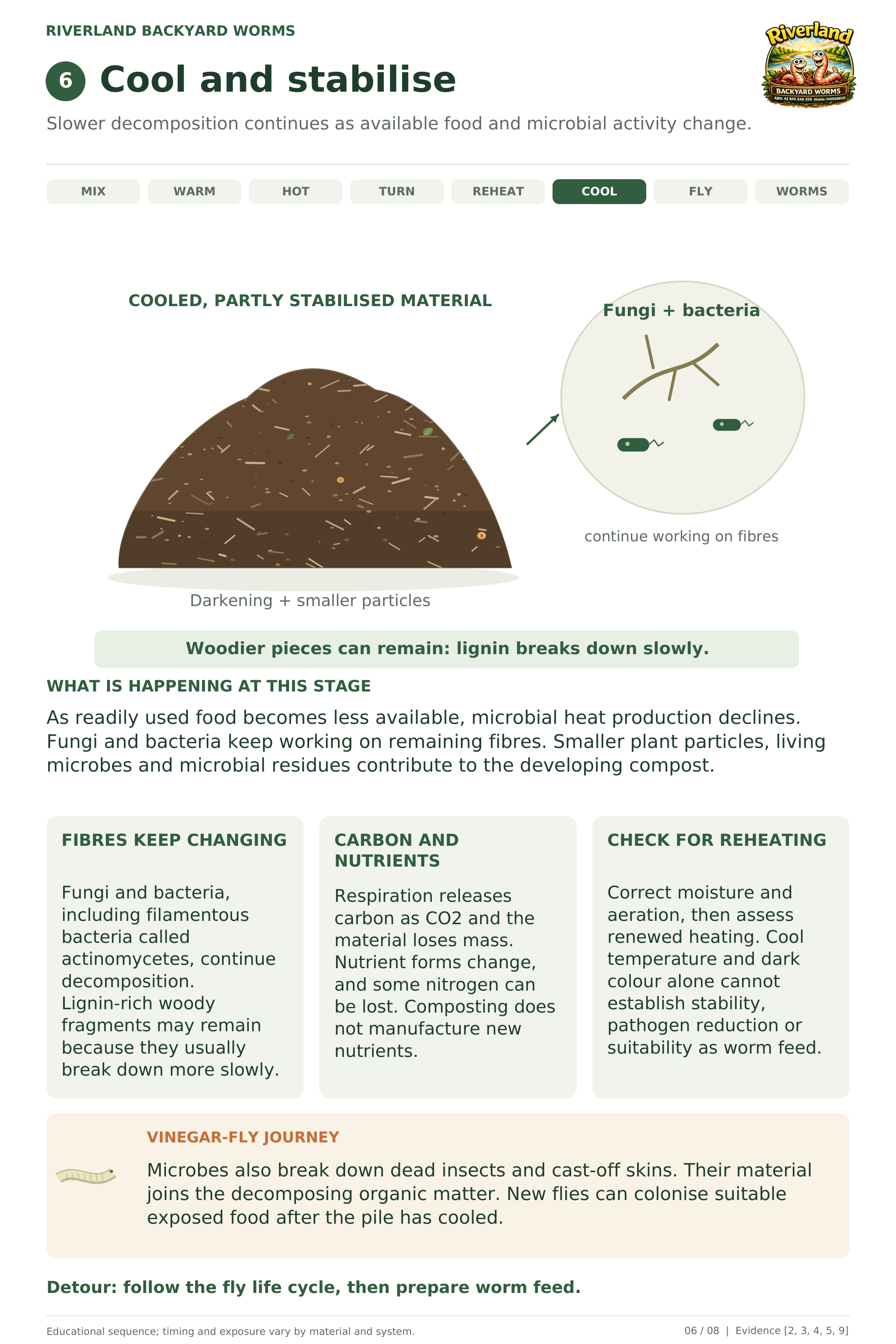
Cool and stabiliseSlower decomposition continues as the material changes.
As readily used food becomes less available, microbial heat production declines. Fungi and bacteria keep working on remaining fibres. Smaller plant particles, living microbes and microbial residues contribute to the developing compost.
Fibres keep changing
Fungi and bacteria, including filamentous bacteria called actinomycetes, continue decomposition. Lignin-rich woody fragments may remain because they usually break down more slowly.
Carbon and nutrients
Respiration releases carbon as CO2 and the material loses mass. Nutrient forms change, and some nitrogen can be lost. Composting does not manufacture new nutrients.
Check for reheating
Correct moisture and aeration, then assess renewed heating. Cool temperature and dark colour alone cannot establish stability, pathogen reduction or suitability as worm feed.
Follow the fly: two outcomesSee why heat exposure and cooler refuges give different outcomes.
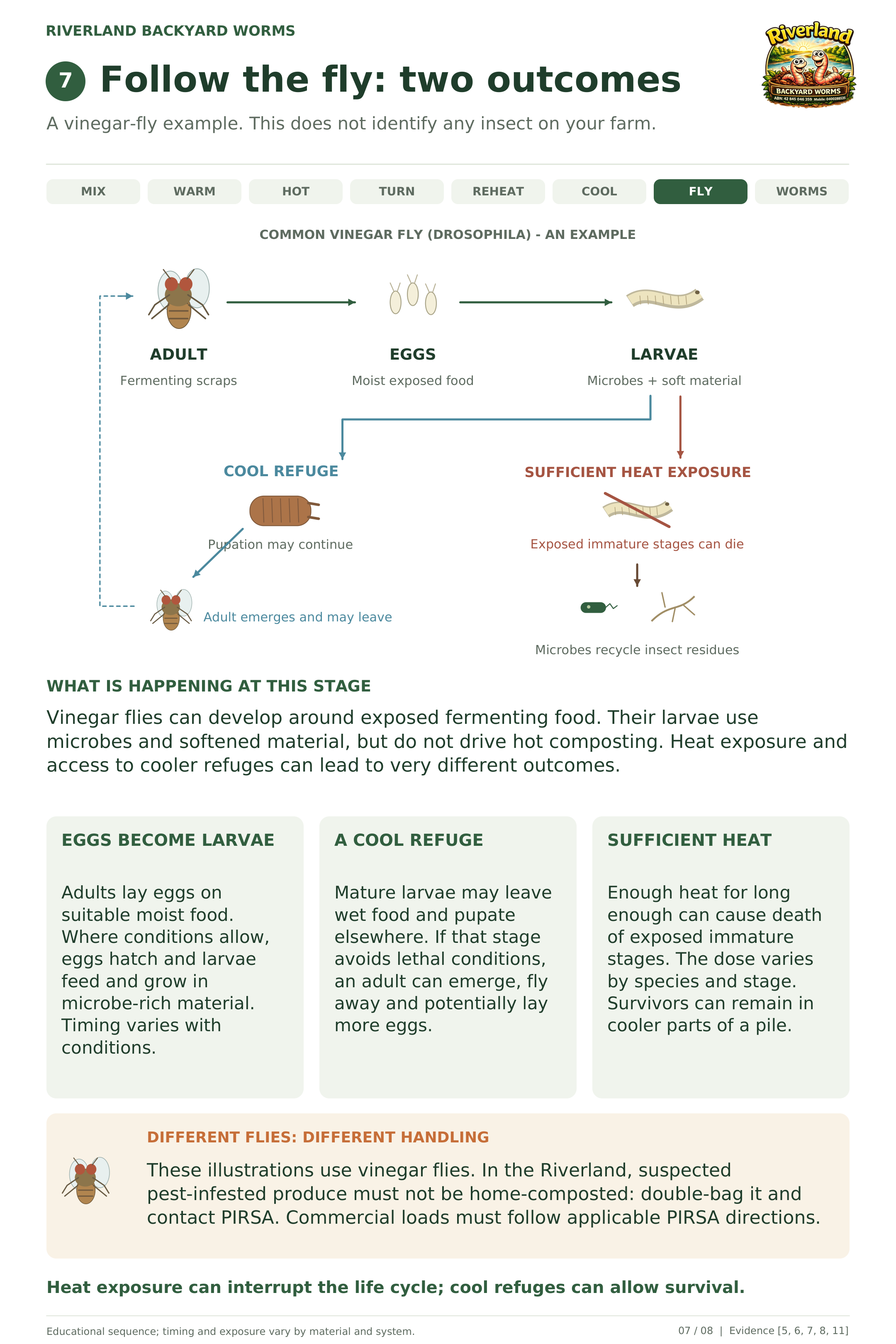
Vinegar flies can develop around exposed fermenting food. Their larvae use microbes and softened material, but do not drive hot composting. Heat exposure and access to cooler refuges can lead to very different outcomes.
Eggs become larvae
Adults lay eggs on suitable moist food. Where conditions allow, eggs hatch and larvae feed and grow in microbe-rich material. Timing varies with conditions.
A cool refuge
Mature larvae may leave wet food and pupate elsewhere. If that stage avoids lethal conditions, an adult can emerge, fly away and potentially lay more eggs.
Sufficient heat
Enough heat for long enough can cause death of exposed immature stages. The dose varies by species and stage. Survivors can remain in cooler parts of a pile.
Cooled compost becomes worm foodIntroduce prepared, cooled feed beside established bedding.
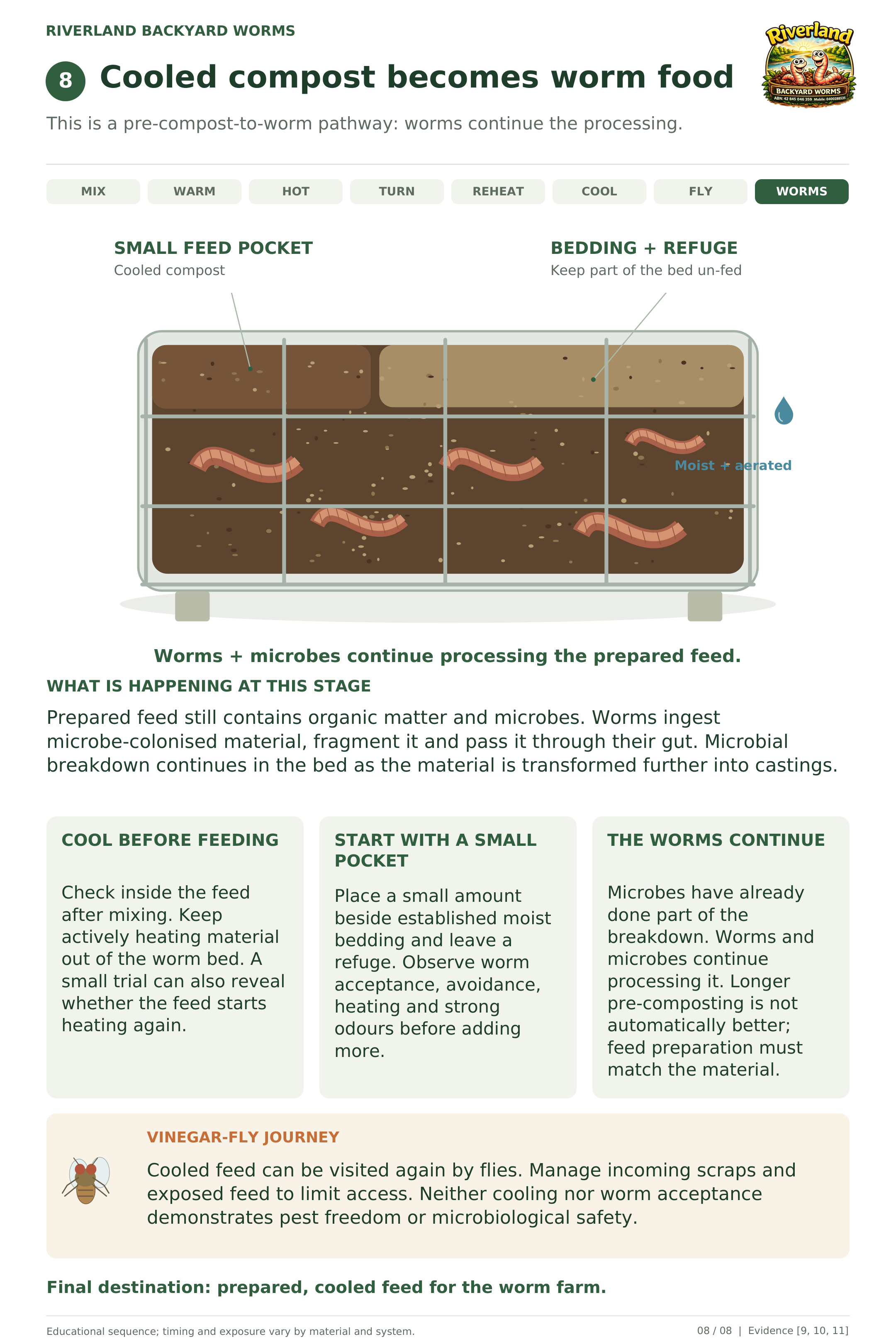
Prepared feed still contains organic matter and microbes. Worms ingest microbe-colonised material, fragment it and pass it through their gut. Microbial breakdown continues in the bed as the material is transformed further into castings.
Cool before feeding
Check inside the feed after mixing. Keep actively heating material out of the worm bed. A small trial can also reveal whether the feed starts heating again.
Start with a small pocket
Place a small amount beside established moist bedding and leave a refuge. Observe worm acceptance, avoidance, heating and strong odours before adding more.
The worms continue
Microbes have already done part of the breakdown. Worms and microbes continue processing it. Longer pre-composting is not automatically better; feed preparation must match the material.
Preparing feed for worms is one stage of our production. The cooled material moves into the beds, while the liquid collection and castings harvest follow separate routes.
See how the two product routes connectInside our Berri farm
Eight beds.
Two product routes.
Our covered half-IBC beds sit in two rows of four beside the shed. Timers manage watering, and collection containers and pumps transfer the liquid through the connected system.
The liquid route
Drainage from the lower beds is collected and reused through the upper beds before reaching the final catchment IBC. From there, we transfer worm juice into storage tanks and drums for collection.
The liquid combines along the way. A handheld reading from one bed cannot tell you the nutrient content of the stored batch.
The castings route
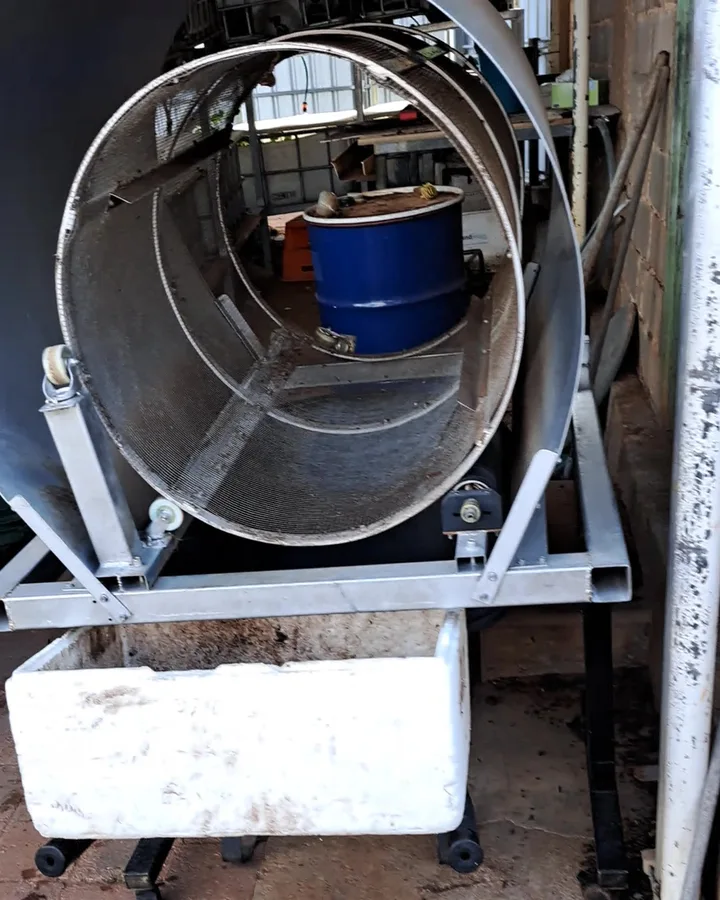
Prepared compost feeds the worms. At harvest, our trommel separates the finer castings from coarser organic material, which goes back for further processing.
Follow the liquid
From bed to catchment
- Four lower bedsE2 & E3E4 & E5
Drainage collected in containers
- Collected liquid transferred toT2 & T3
The first pair of upper beds
- Transfer drum
A submersible pump moves the collected liquid on
- T4 & T5
The remaining pair of upper beds
- Catchment IBC
Combined worm juice transferred into storage tanks and drums
Peer-reviewed research and composting guidance
These original studies explain the biology and help guide our questions. They are not tests of Riverland Backyard Worms products, and their results cannot be transferred directly to our apricot feed, juice or castings.
Feed preparation and collected worm juice
- Nair et al. (2006), Bioresource Technology: Effect of pre-composting on vermicomposting of kitchen waste.
Pre-composting helped the particular kitchen-waste mix studied. Its nine-day result is not a timetable or treatment claim for our apricot feed.
- Hanc & Pliva (2013), Journal of Material Cycles and Waste Management: Vermicomposting technology as a tool for nutrient recovery from kitchen bio-waste.
Compared raw and pre-composted feeds under controlled conditions. Outcomes depend on the material, preparation and worm-bed management.
- Mupondi et al. (2011), Waste Management & Research: Effects of a precomposting step on the vermicomposting of dairy manure–waste paper mixtures.
Longer pre-composting reduced microbial and soluble carbon and could reduce worm growth in that manure–paper mix. More ageing is not automatically better feed preparation.
- Churilova & Midmore (2019), Horticulturae: Vermiliquer (Vermicompost Leachate) as a Complete Liquid Fertilizer for Hydroponically-Grown Pak Choi in the Tropics.
Measured collected leachate in managed hydroponic experiments, including pH adjustment and aeration. This does not establish crop performance or storage behaviour for our juice.
Microbes, heating and plant-fibre breakdown
- Yeh et al. (2020), Applied Sciences: Optimizing Food Waste Composting Parameters and Evaluating Heat Generation.
Shows how moisture, structure and management affect biological heating. The optimum mix was specific to that study.
- Antunes et al. (2016), Scientific Reports: Microbial community structure and dynamics in thermophilic composting viewed through metagenomics and metatranscriptomics.
Supports the explanation of microbial activity and the effects of turning on access to oxygen and substrate. It does not prescribe a turning calendar.
- López et al. (2021), Frontiers in Microbiology: Characterization of Thermophilic Lignocellulolytic Microorganisms in Composting.
Describes enzyme activity and changing microbial groups during plant-waste composting. Resistant woody material can persist.
- Zhang et al. (2022), Engineering in Life Sciences: Study on dynamic changes of microbial community and lignocellulose transformation mechanism during green waste composting.
Supports continued material transformation through warming, heating, cooling and maturation. Organisms and rates vary with the feedstock.
Vinegar flies, pest risks and South Australian directions
- Feder, Blair & Figueras (1997), Functional Ecology: Natural thermal stress and heat-shock protein expression in Drosophila larvae and pupae.
Heat effects depend on exposure and life stage. Laboratory median-lethal-time results are not eradication schedules or approved compost treatments.
- Jiménez-Padilla et al. (2024), Journal of Experimental Biology: Live yeasts accelerate Drosophila melanogaster larval development.
Explains the importance of yeasts to vinegar-fly larvae. Flies are not the main driver of hot composting.
- Kendra et al. (2007), Florida Entomologist: Residential composting of infested fruit: A potential pathway for spread of Anastrepha fruit flies.
Some adults emerged from residential piles. The study involved Caribbean fruit fly in Florida, not Queensland fruit fly in South Australia.
- Casares et al. (1997), Genetics Selection Evolution: Analysis of larval behaviours underlying the pupation height phenotype in Drosophila simulans and D. melanogaster.
Larvae can move away from where they first fed; pupation-site choice depends on conditions and genetic background.
- PIRSA: Disposing of fruit and vegetable waste at home.
Current South Australian biosecurity guidance. Suspected pest-infested produce in the Riverland must not be home-composted.
- PIRSA: Disposing of restricted fruit and vegetable commercial waste during an outbreak.
Commercial fruit waste must follow applicable PIRSA directions and waste management plans. These illustrations are not an approved fruit-fly treatment.


